July 19, 2026 · Engineering
Building EnvSift around a privacy constraint
How keeping ENV contents in the browser defined EnvSift's architecture, six-tool scope, and v1.0.0 release.
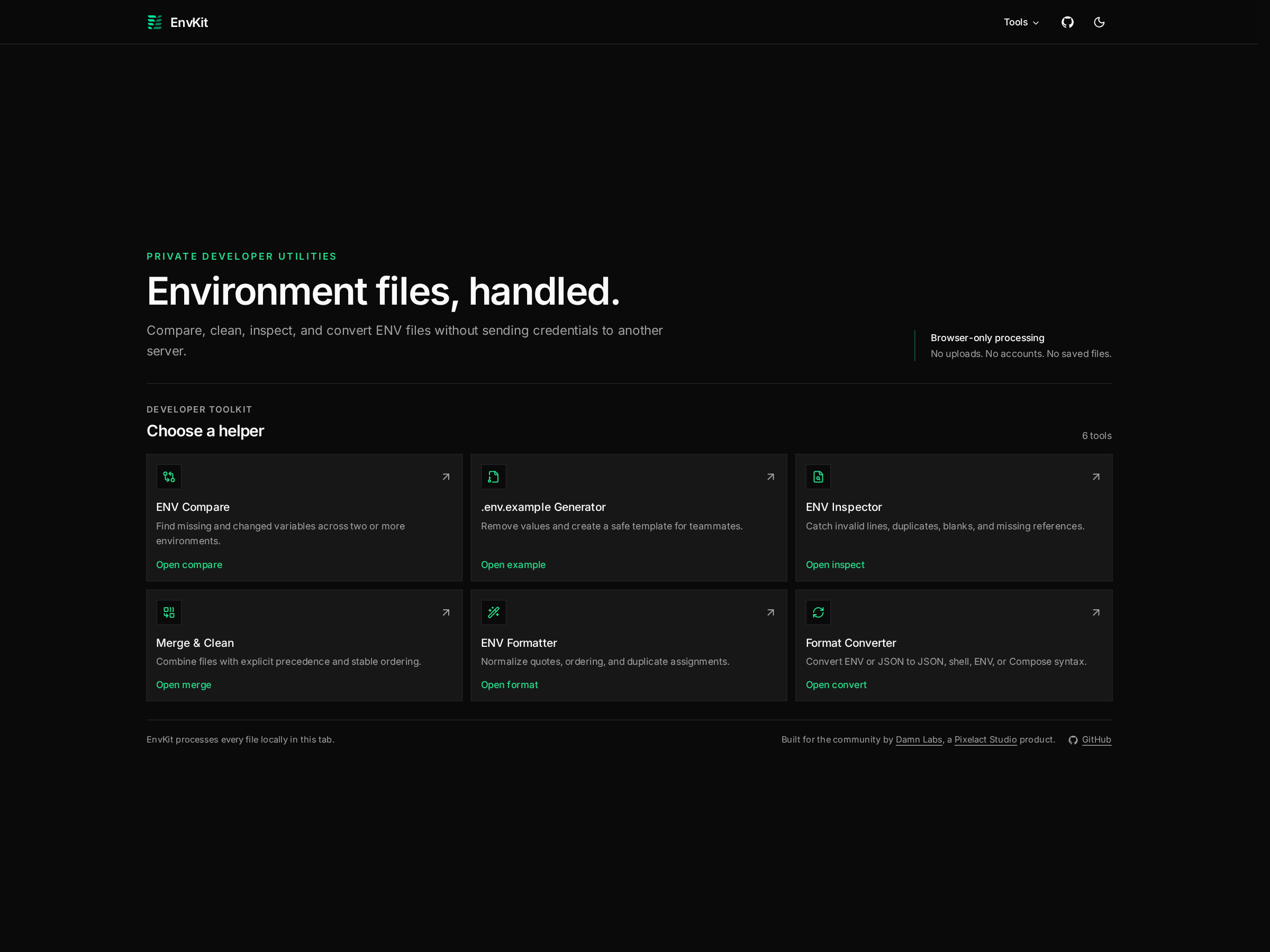
The shortest product rule for EnvSift is also the most important one: pasted values and local files stay in the browser.
Environment files often contain credentials. A tool that uploads them to a server would ask for trust before it had done anything useful. EnvSift avoids that trade entirely by processing input inside the tab.
The constraint became the architecture
Browser-local processing means no upload step, no account, and no saved file on a backend. The app only needs to help with the file in front of you. That kept the architecture aligned with the privacy promise and kept unrelated product surface out of the first release.
It also made the boundary easy to explain.
Open EnvSift →
The live app can work with the contents of an ENV file without receiving those contents on a server.
Six jobs, one toolkit
Version 1.0.0 covers six focused jobs: comparing ENV files, generating a safe
.env.example, inspecting common problems, merging and cleaning files,
formatting them, and converting between supported formats.
That scope is intentionally finite. These tasks belong together, but they do not need a workspace, cloud storage, or a broader platform around them. Each tool opens directly and does the job it names.
Released, with the boundary intact
View EnvSift on GitHub →
Read about Damn Labs →
EnvSift is now released as a free open-source project from Damn Labs. The useful result of the privacy constraint is not a marketing claim. It is a product architecture that does not need the sensitive data in the first place.